

Most businesses don’t have a marketing problem. They have a strategy problem that shows up as a marketing problem.
The symptoms are familiar: decent traffic with almost no leads, ad spend that climbs every quarter while cost per acquisition barely improves, content that gets produced on schedule but never seems to land with the right people. None of these are channel failures on their own. They’re what happens when execution runs ahead of thinking.
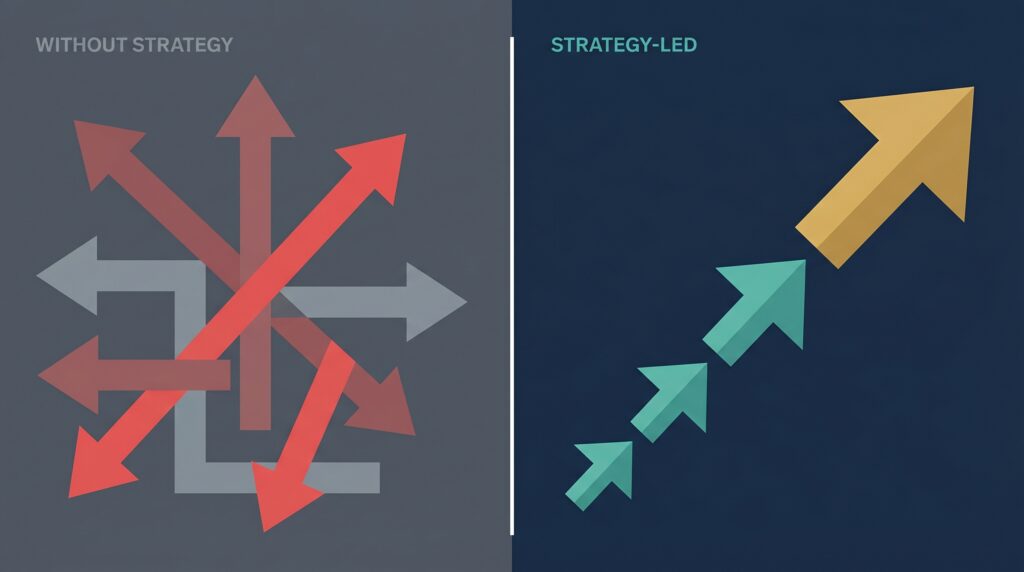
Marketing without a defined strategy is just spending money in a general direction and hoping the market responds.
What “Strategy-Led” Actually Means
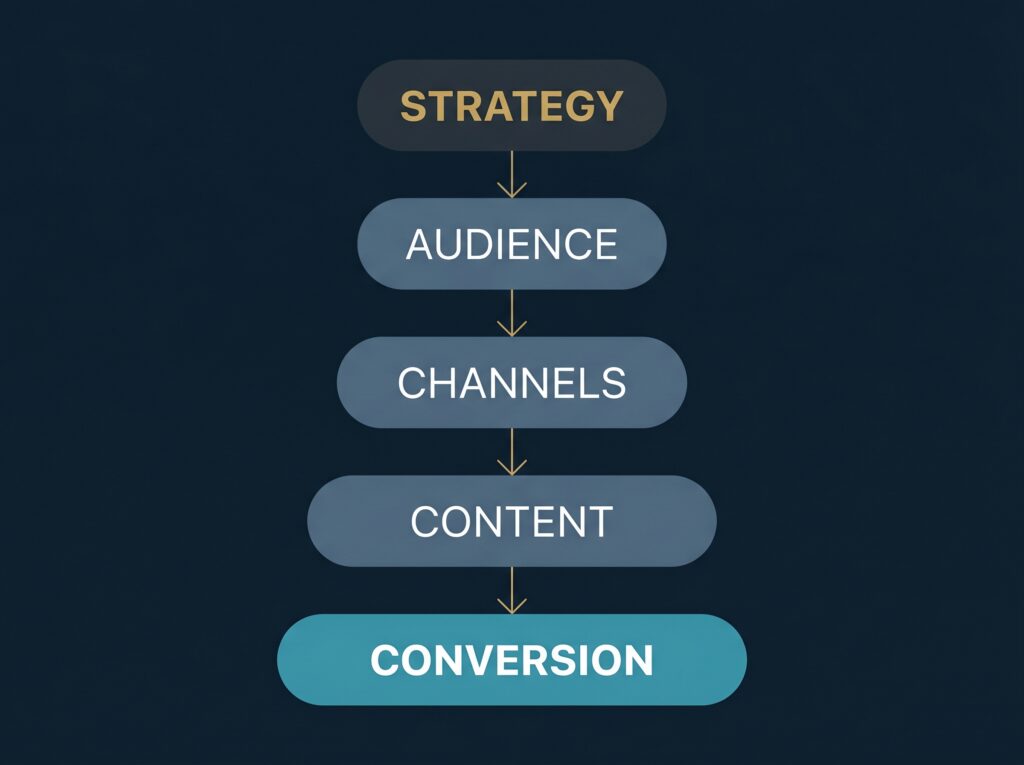
Strategy-led marketing starts with a clear answer to a question most businesses skip: who is this for, what do they need to hear, and where are they when they’re ready to hear it?
That sounds deceptively simple. But without it, everything downstream (your SEO keyword targets, your ad messaging, your landing pages, your email sequences) gets built on assumptions. And assumptions compound. A homepage written for “everyone” converts no one. A PPC campaign targeting broad keywords burns budget on clicks that were never going to convert. A blog that covers every topic loosely ends up owning none of them in search.
Strategy-led marketing means every tactic is traceable back to a business objective. Not a vanity metric or a channel goal, but rather an actual outcome the business cares about.
The Disconnect Most Businesses Don’t Catch
Here’s where it usually breaks down: a company hires someone to “do SEO” or “run ads” without first establishing what success looks like, who they’re targeting, or what makes them the better choice for that target.
The execution starts. Content gets published. Ads go live. Traffic comes in. And then, three months later, someone asks why the leads aren’t there. The honest answer is that no one decided what a qualified lead even looked like before the campaign launched.
This isn’t a knock on execution. Execution done well matters enormously. But execution without direction is just motion. You can be technically excellent at SEO and still rank for keywords your buyers never search. You can run a paid campaign with a strong quality score and still send traffic to a page that doesn’t speak to the person who clicked.
The traffic problem and the lead problem are almost always the same problem: the strategy wasn’t there to begin with.
What Changes When Strategy Comes First
When marketing is built around a strategy, the decisions get easier and the results get more predictable.
Keyword selection becomes about buyer intent, not search volume. You stop chasing terms that look good in a report and start targeting the specific questions your best prospects ask when they’re two weeks away from making a decision. The content you create answers those questions directly, which means the traffic it generates is actually worth having.
Paid media stops being an experiment and becomes a system. You know which audience segment has the shortest sales cycle. You know what message gets them to click and what the page needs to say when they land. You can run a tight campaign, measure it cleanly, and scale what works — because you understood the buyer before you spent the first dollar.
Conversion optimization has something to work with. When you know who you’re talking to and what they care about, a weak headline isn’t a mystery — it’s a fixable problem. You can test with purpose instead of guessing.
Analytics finally tells you something useful. When strategy defines what “working” looks like, your reporting reflects progress toward real goals instead of surfacing metrics that look good but don’t connect to revenue.
The Business Case for Getting This Right

Businesses that invest in strategy before execution consistently outperform those that don’t, because it eliminates the waste. Every dollar spent on execution that’s aligned to a clear strategy compounds. Every dollar spent without it dilutes.
Agencies and competitors who have moved toward outcome-driven, integrated strategy are capturing the high-intent searches, winning the comparison searches, and shortening their clients’ sales cycles. The ones stuck in a “post-and-pray” or “run-ads-and-wait” model are leaving real money on the table.
If your marketing feels busy but not productive, the fix rarely lives in the tactics. It lives one level up.
Where to Start
The good news is that getting strategy-led doesn’t require starting over. It requires stopping, asking the right questions, and making sure the answers are actually reflected in what you’re running.
That means auditing what you’re doing now against what you’re trying to achieve. It means defining your target audience with enough specificity that your messaging can actually speak to them. It means setting KPIs that connect to pipeline and revenue over traffic and impressions.
If that feels like a big lift to do internally, that’s exactly what a good marketing partner should help you do before a single campaign goes live.
Ready to build a marketing program that’s actually tied to your business goals? Book a call with our team or get your free assessment.