
- Digital Marketing
- Updated 07/15/2026
The Top 3 B2B Marketing Challenges Teams Face
Summarize this post
At some point in almost every conversation with a new client, someone says a version of the same thing.
It might be “we’re getting leads but they’re the wrong ones.” Or “we’ve tried three agencies and nothing stuck.” Or the one I hear most often: “honestly, we can’t really tell what’s working.”
These aren’t random complaints. They’re the same three problems, showing up in different clothes. And if you’re a B2B marketer at a company with a complex product and a small team, at least one of them probably lives in your inbox right now.
1. You can’t tell if any of it is working
This is the one that keeps marketing leaders up at night – and the one that’s hardest to explain to anyone who doesn’t live in it.
B2B attribution is structurally broken for most companies. Your deals take months. Your buying committee has six people. The thing that actually tipped the decision – a whitepaper someone forwarded in Slack, a post your prospect read three times before reaching out, a conference conversation from eight months ago – never shows up in your dashboard. By the time the contract is signed, the trail is cold.
CMI’s 2026 B2B Content and Marketing Trends report surveyed 1,015 B2B marketers and found measuring effectiveness has been a top-three challenge for multiple years running. Year after year. Despite new tools, new platforms, new AI-powered analytics suites. The tools are not the problem.
The problem is that most attribution infrastructure was built for e-commerce – fast cycles, individual buyers, trackable clicks. B2B buying doesn’t work that way. It never did. And when your leadership asks “what’s working,” you’re left answering with the piece of it you can prove, which is usually not the full picture.
The organizations getting this right aren’t building better dashboards. They’re getting honest about what’s unmeasurable and building reporting that reflects how B2B buying actually works – dark funnel and all.
2. Nobody outside your network knows you exist
Most B2B companies are genuinely excellent at selling to people who already know them. That’s not a small thing – referrals close fast, trust is already there, and the work tends to be good because the fit is good.
The problem shows up when it’s time to grow. New market, new geography, new segment – and there’s nothing. No demand infrastructure, no brand presence, no search visibility. Just a very good company that the right people have never heard of.
Here’s what makes this harder than it sounds: 91% of B2B marketers increased their content output in 2025 (CMI, 2026). The noise your ideal buyers are navigating has never been louder. And they’re doing more independent research before talking to anyone – industry estimates put buyers at roughly 80% through their evaluation before they contact a vendor. If you’re not visible during that research phase, you don’t get a discovery call. You don’t get a chance to explain what makes you different. You just weren’t there.
Positioning and differentiation was the single most common strategic challenge written down by CMOs at the Renegade CMO Super Huddle in 2025 – a room of 52 marketing leaders, writing their real answers on cards. Not AI trends, not budget cuts. Differentiation.
The companies that grow past their referral ceiling are the ones that show up before the buyer decides who to call.
3. Your website doesn’t reflect how good you actually are
I say this carefully, because it’s not an insult – it’s almost a structural inevitability for companies at a certain stage.
You built the website when things were different. Or the team that built it didn’t fully understand the product. Or it’s been updated piecemeal for years and the voice is now some averaging of six different people’s drafts. Whatever the history, you look at it now and it doesn’t match what you’d actually say to a client in a room.
For most B2B companies, the website sits on the “we should fix that” list for a long time. There’s always something more pressing. And it’s genuinely hard to see from the inside – you know what you do so well that the gaps in the writing aren’t visible to you anymore.
What’s harder to see is the cost. Specialist buyers – engineers, researchers, architects, compliance leads – do real diligence before reaching out. They read your case studies. They read your about page. They look for evidence that you understand their world at the level they operate at. When the language is generic (“experienced team,” “proven process,” “client-focused approach”), they don’t call to find out if there’s more substance behind it. They just don’t call.
You never find out you lost them.
Why all three tend to show up at once
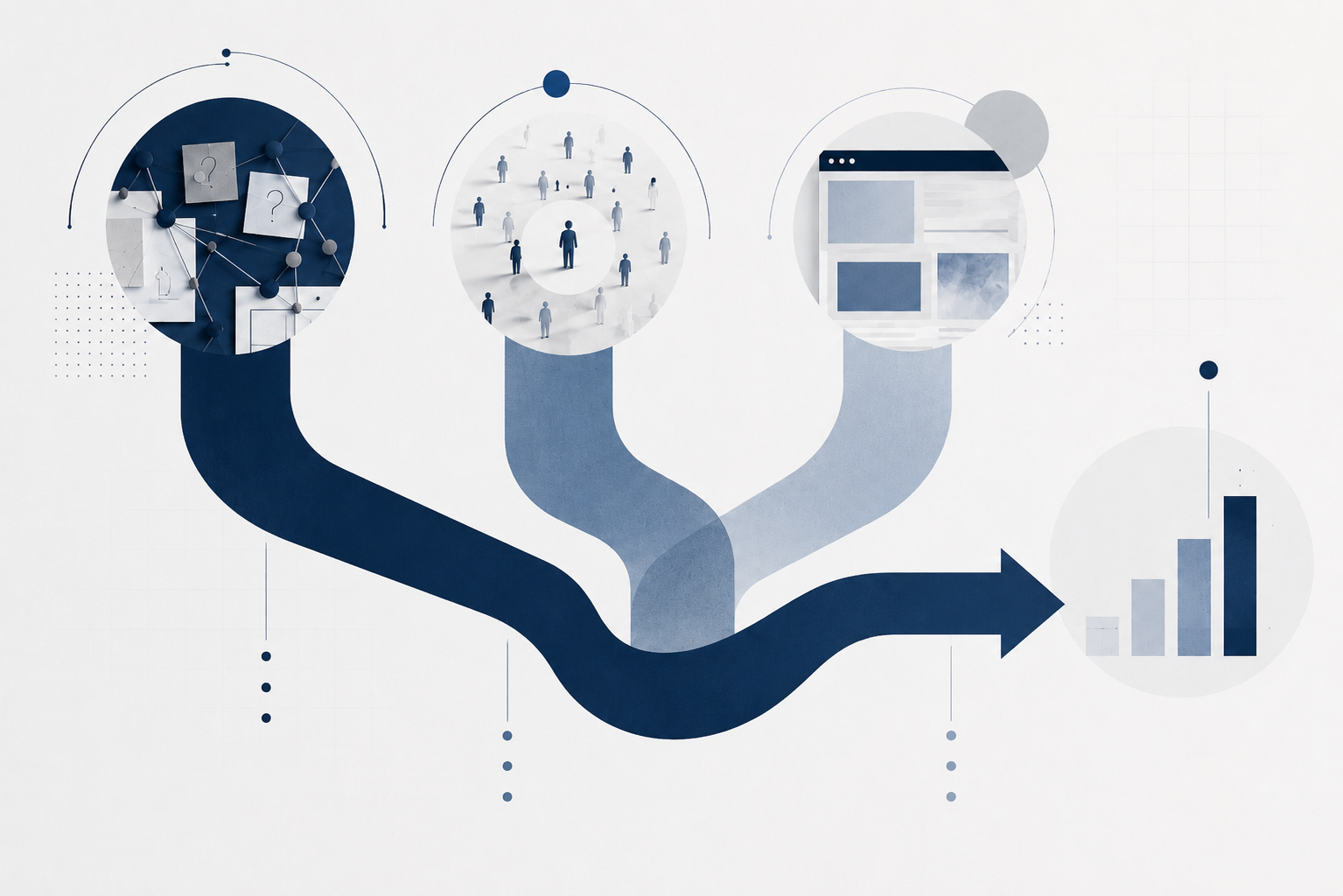
They’re not separate problems. They feed each other.
A weak website means your demand generation efforts hit a harder ceiling – people show up, don’t trust what they see, and leave. No brand presence outside your network means you’re pipeline-dependent on referrals, which makes attribution messier. And if you can’t prove what’s working, making the case for investment in fixing any of it is an uphill conversation.
None of it gets solved by adding a new tactic or trying a different channel. The fix is upstream: clear positioning, a website that earns trust with the buyers you actually want, and marketing activity connected to real pipeline metrics.
That’s the work we do. If it sounds familiar, let’s talk.