
- Digital and Design Strategy
- Digital Marketing
- Published 08/04/2026
B2B Marketing Strategy for Industrial and Manufacturing Companies
Summarize this post
Good product. Capable team. Marketing budget. None of it working the way it should.
When industrial companies hit this wall, the instinct is to fix the campaigns… add paid spend, rebuild the website, hire a new agency. But campaigns rarely cause this problem. They inherit it. The problem sits upstream, at the strategy level: wrong audience, wrong message for where buyers actually are, wrong content for how engineers evaluate.
Industrial marketing fails in ways that differ from most B2B marketing failures. The buyers are different. The buying process is different. The evaluation criteria are different. And the mistakes, while common across the sector, are usually invisible until you see them from the outside.
This post covers what those strategy failures look like, how four industrial and technical companies worked through them, and what a modern industrial marketing strategy needs to address. If you’re already investing in marketing and not seeing the results your product deserves, the problem is almost certainly in the strategy, not the execution.
Key Takeaways
- Industrial marketing problems usually begin upstream: the wrong audience, the wrong message for the buyer’s stage, the wrong evidence for a technical evaluation, or the wrong stakeholder. More campaign activity only amplifies the mismatch.
- Technical buyers complete an average of 62% of the buying process online before speaking with sales, according to GlobalSpec’s 2026 research. Marketing is shaping the shortlist long before sales sees the opportunity.
- A single message cannot support an entire buying group. Gartner reports that B2B buying teams can span five to 16 people across as many as four functions, each with different priorities.
- Technical credibility comes from useful evidence: specifications, application notes, expert-authored guidance, demonstrations, and case studies with real constraints and outcomes.
- AI is becoming part of technical research, but it has not replaced verification. In GlobalSpec’s 2026 study, 69% of technical buyers reported using generative AI during a purchase, while rating its trustworthiness only 4.7 out of 10. Clear, well-sourced, machine-readable content matters to both the buyer and the systems helping them research.
Why industrial marketing is different
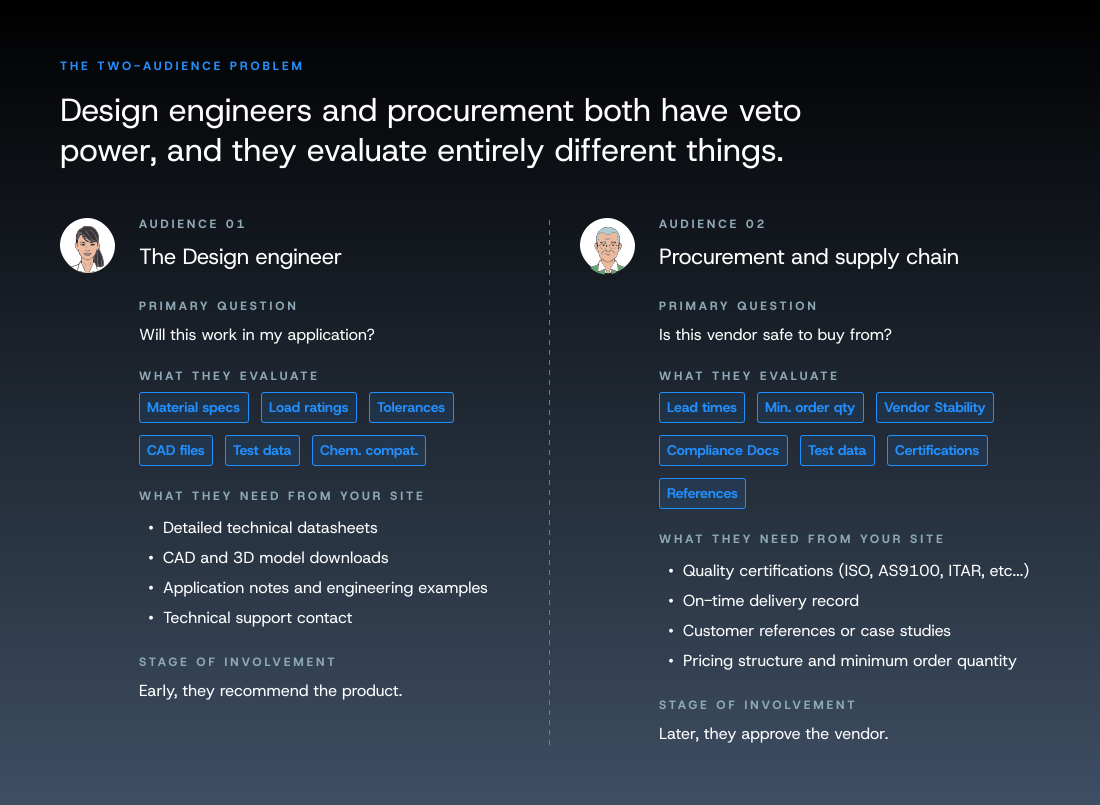
Start with who you’re selling to. In most industrial buying decisions, there are at least two distinct audiences with different evaluation priorities that rarely overlap.
The Buyer and the Influencer
Design engineers evaluate on technical fit: application compatibility, material specs, performance tolerances, reliability data, and how your solution integrates with what they’re already running. They want application notes, CAD files, and detailed product documentation. They’re skeptical of marketing copy and they know within a few sentences whether the person who wrote it understood what they’re building.
Procurement evaluates on vendor stability, delivery performance, compliance documentation, warranty terms, and total cost of acquisition. They’re not reading your application notes; they’re checking whether you can meet their lead times and whether your quality management system is certified.
One piece of content almost never serves both.
Long, complex sales cycles
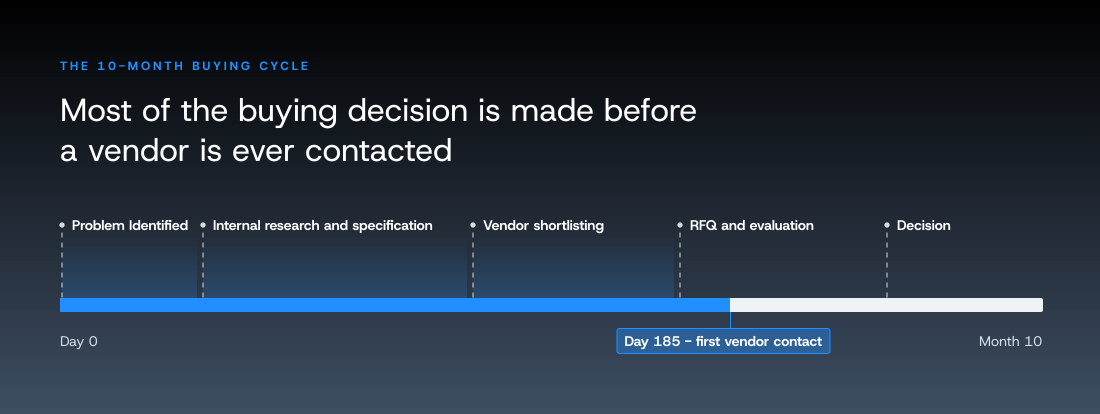
Layered on top of the dual-audience challenge is the buying timeline. In GlobalSpec and TREW Marketing‘s 2026 survey of technical buyers, respondents said they complete an average of 62% of the buying process online before speaking with someone at the company. A separate 6sense study of nearly 4,000 B2B buyers found an average buying cycle of 10.1 months, with first seller contact occurring 61% of the way through the journey.
The buying group is also larger and less unified than the familiar “engineer plus procurement” shorthand suggests. Gartner’s 2025 survey found that 74% of B2B buyer teams experienced unhealthy conflict, while groups that reached consensus were 2.5 times more likely to report a high-quality deal.
“Buying groups are more diverse than ever, ranging from five to 16 people across as many as four functions.”
Delainey Kirkwood, Principal, Research, Gartner
That means your marketing is doing qualification work your sales team never sees. It decides whether you get considered at all, building the technical credibility that earns you a spot in the evaluation or removes you from it. When marketing gets this work wrong, your salespeople are left working with an audience that has already formed opinions about your company, opinions your marketing shaped, or failed to shape.
The deal economics are also different from most B2B categories. Industrial companies often sell high-value, low-volume. That changes what pipeline metrics matter, how lead generation should be structured, and why chasing high lead volume usually produces the wrong results.
The audience map: where industrial marketing most often fails
If there’s a single place industrial marketing breaks down most consistently, it’s in the audience map: not understanding who actually influences the buying decision, how far along buyers are when they find you, and what they need from the content they encounter.
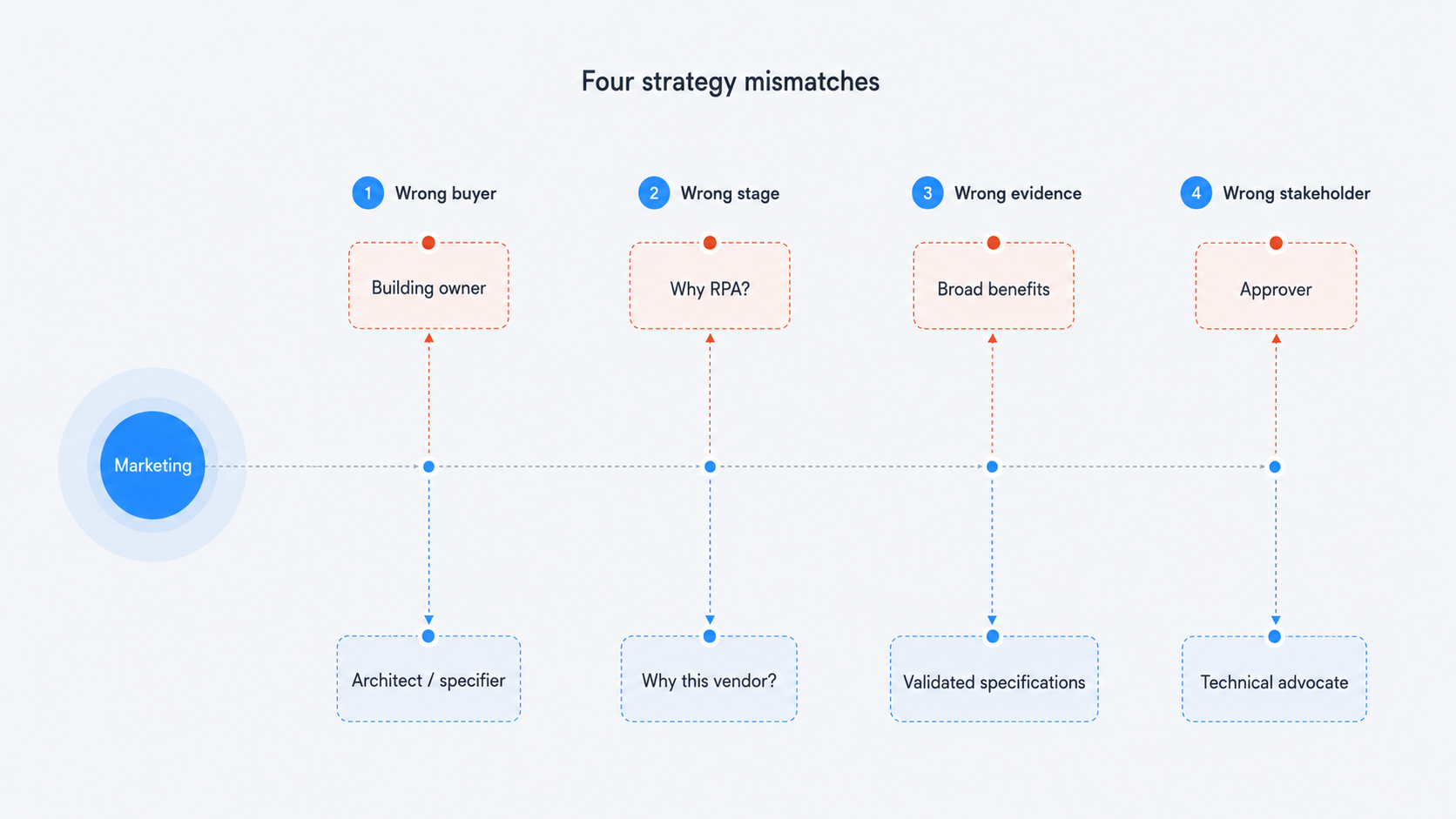
Four client situations illustrate this clearly. Each one had functioning products and real market demand. Marketing started working when the strategy matched how buyers actually buy.
Insulgard: Marketing to the wrong buyer entirely
Insulgard makes security glazing, a ballistic-rated and forced-entry-resistant glass system used in banks, government facilities, and critical infrastructure. When we started working with them, their marketing was aimed at building owners. Which made intuitive sense: building owners write the checks.
The problem was that building owners don’t specify glazing. Architects do, often years before the building owner is meaningfully involved. By the time a building owner enters the conversation, the specification has already been written. If Insulgard wasn’t in it, they weren’t getting the contract, regardless of how good their product was or how well their marketing performed.
This wasn’t unique to one security-glazing company. The American Institute of Architects’ 2026 specification research describes architects as central to researching, evaluating, and selecting building products. Earlier AIA research found that 83% of respondents considered architects significant players in discovering new products and materials.
Redirecting the strategy toward architects changed everything. Inbound leads went from one per month to more than eighty, a 7,900% increase. The product hadn’t changed. The budget hadn’t changed. The audience had.
The lesson isn’t specific to security glazing. In any market where a specifier, designer, or technical advisor influences the purchasing decision before the buyer with budget authority is involved, marketing to the end-buyer misses the actual decision point. The person who pays is not always the person who decides.
Ashling Partners: Already past the question you’re answering
Ashling Partners is a digital transformation consultancy specializing in robotic process automation. When we first looked at their marketing, the content was educating prospects on why they needed RPA: explaining the technology, the use cases, the business case for automation. It was well-produced and technically credible.
It was also answering a question their buyers had stopped asking months ago.
By the time someone is evaluating an RPA consultancy, they’ve already decided they need RPA. The category decision is settled. What they’re doing now is evaluating vendors. They want evidence that this particular firm understands their environment, has relevant delivery experience, and won’t create more problems than they solve.
That pattern extends well beyond RPA. In 6sense’s 2025 buyer study, buyers entered a purchase with prior experience with an average of 3.8 of the five vendors they would evaluate. They had already placed 3.6 of those vendors on a shortlist on the first day—and the eventual winner came from that Day One shortlist 95% of the time. In a mature category, marketing often needs to establish vendor preference before a prospect is ready to talk, not keep explaining why the category exists.
Category education is only useful during early market formation, when buyers genuinely don’t know the technology exists or what it can do.
Ashling’s buyers were past that stage. Their content needed to move from “here’s why you should consider RPA” to “here’s why Ashling is the firm you should trust with this implementation.” The two messages serve completely different moments in the buyer’s journey, and confusing them meant the content was doing the wrong work.
This is more common than it looks. Companies that were early in a category often keep producing category-education content long after the market has moved on, because that content worked during the early years.
Arbor Assays: The specification is the message
Arbor Assays produces assay kits for life science researchers. These are highly specific tools for measuring particular biomarkers in biological samples. Their buyers are lab researchers: scientists evaluating ELISA kits for specific applications.
When they ran voice-of-customer research, the feedback was consistent. Researchers wanted specification data. They wanted to know which animal models had been validated, the exact sensitivity range, the cross-reactivity profile, delivery timelines, storage requirements. They weren’t looking for benefit-oriented messaging or narrative content about transforming research; they were gathering the technical information they needed to make a purchase decision.
“Application notes are also particularly important on company websites.”
– Gary Lerude, former Editor, Microwave Journal
The instinct in most marketing is to lead with benefits, to build a warmer story around what the product makes possible. For Arbor Assays’ buyers, that approach was actually counterproductive. Researchers evaluate reagents the way scientists evaluate anything: on reproducible, documented evidence. The presence of detailed, validated specifications was itself the credibility signal.
Generic benefit messaging read as a sign that the company didn’t understand how researchers buy.
In technical B2B, the specification often is the benefit. Specificity resonates with technical buyers in a way that softer messaging can’t.
The broader technical-buyer research supports this preference for demonstrable expertise. In GlobalSpec and TREW Marketing’s 2026 study, 66% of respondents rated an engineering expert at a vendor as very or extremely trustworthy, “the highest-rated author type,” compared with 10% for a generative AI tool.
Modelon: The advocate isn’t the approver
Modelon sells simulation software used by engineering teams in aerospace, automotive, and energy. These are sophisticated modeling tools that form a core part of how engineers run complex systems simulations. Their initial marketing was aimed at engineering managers: messages about cloud collaboration, faster time to market, team-level productivity.
These were the right messages for the people who approve the purchase.
But the people actually starting the conversation were hands-on engineers, individual contributors looking to test new tools, explore new approaches to problems they were already working on. Their questions were completely different.
They weren’t asking about productivity dashboards or organizational efficiency. They were asking what Modelon’s solver was like, what they could do that they couldn’t do in Dymola, how the model library coverage compared in their application area, whether the workflow fit how they actually ran simulations day to day.
The approver and the advocate were two different people with two different sets of questions. Marketing to the approver with content about organizational benefits meant the advocates (who were initiating the actual conversations) didn’t have the technical content they needed to get excited. And marketing to advocates with technical content doesn’t move approvers who need to see a business case.
Both groups matter. Both need content designed for where they sit in the buying process.
The goal isn’t to personalize each stakeholder into a separate silo. It is to give each person the evidence they need while helping the group reach the same conclusion. Gartner found that tailoring content to the buying group’s shared priorities improved consensus by 20%, while content tailored only to individual relevance had a 59% negative impact on consensus.
These four situations have one thing in common: the problem wasn’t the campaigns. Better creative wouldn’t have fixed Insulgard. A higher ad budget wouldn’t have helped Ashling. These were audience map failures, and execution doesn’t fix a strategy problem.
What a modern industrial marketing strategy looks like
Once the audience map is right, the rest of the strategy can be built around it. Five areas where industrial marketing strategy differs from generic B2B approaches:
Positioning for how engineers actually evaluate
Vague benefit messaging doesn’t move technical buyers. “Innovative solutions for the modern manufacturer” tells a design engineer nothing useful. Positioning for an industrial company needs to be built around the specific evaluation criteria buyers apply — what they compare you against, where you win those comparisons, and how you demonstrate that clearly before a sales conversation.
This starts with competitive context. Buyers don’t evaluate in isolation. They’re choosing between your solution and an alternative — a competitor’s product, an incumbent system, a fabricated workaround, or staying with what they have. Understanding how those comparisons resolve in your favor, and building positioning around those specific resolution points, is what makes marketing useful to a technical buyer rather than background noise.
It also means being specific about industry, application, and buyer role. Positioning that works for an engineer specifying material for an automotive application won’t work for a procurement director sourcing for defense. Even if they’re buying the same product.
“You cannot be chosen if you are not recognized.”
Morgan Norris, Senior Brand Manager, TREW Marketing
Content that builds technical credibility
Technical buyers trust evidence. What that evidence looks like depends on the buyer and the evaluation moment, but a few content types consistently carry the most weight.
Application notes, which show actual performance data in specific conditions, earn more trust than any amount of benefit messaging. Case studies matter, but only when they include real numbers and constraints specific enough that a buyer can map them to their own situation. Not “our customer improved their process,” but what changed, by how much, and under what conditions.
Video is consistently one of the highest-performing formats, but the kind of video matters. In a 2024 Content Marketing Institute survey of 104 manufacturing marketers, 74% said video produced the best results, the highest of any format measured. GlobalSpec’s buyer-side research adds useful detail:
- 62% of technical buyers value how-to or installation videos
- 51% value engineering deep dives
- 47% value product demonstrations
Product documentation often gets overlooked as a marketing tool. Specifications organized around how buyers compare options, rather than how the company catalogs its products, do real evaluation work. Comparison content fills a similar gap for markets where buyers are narrowing down between two or three known alternatives.
The same 2026 GlobalSpec study found that 74% of technical buyers routinely use supplier or vendor websites while researching work-related purchases. That places product pages, specification tables, selection tools, and technical documentation inside the buying process, not on the periphery of marketing.
Advocate-facing content is the most underused. These are materials internal champions use to make the case to approvers who haven’t engaged with your marketing directly. The buying committee typically includes multiple people, and not all of them will find your content independently.
Most industrial companies underinvest in the content that enters the conversation early. By the time someone downloads your product datasheet, they’ve already formed opinions about your company. The earlier content they encountered shaped those opinions, and the absence of it left a gap someone else filled. That investment takes longer to show results, which makes it easy to deprioritize. It’s also what fills the pipeline six months from now.
SEO and GEO/AEO for industrial search
Engineers search with specificity. They’re not searching “industrial filtration solutions”; they’re searching for specific material grades, model numbers, application types, tolerance ranges, or a combination of parameters that defines their problem. Industrial SEO built around broad commercial terms misses actual search behavior.
This has a structural implication for keyword strategy: research should start with how buyers describe the problem in technical terms, not how marketers describe the solution in benefit terms. Those vocabularies are often quite different.
Traditional search still leads technical research, but AI optimization is now part of the process. In GlobalSpec’s 2026 study, 77% of technical buyers said they use a traditional search engine more often than a generative AI platform, yet 69% use generative AI at least occasionally when evaluating a work-related purchase. These buyers are not accepting the answer uncritically: they rated AI answers only 4.7 out of 10 for trustworthiness. Among respondents who noticed AI-generated search summaries, 69% read the summary and continued to the source results; only 6% said the summary was usually enough.
That creates a new visibility requirement. When a buyer asks an AI system which manufacturers produce a specific sensor for a particular application, the system needs sources it can retrieve, interpret, and cite: direct answers, concrete specifications, relevant application context, expert authorship, and evidence supporting important claims.
The foundational Generative Engine Optimization study published at KDD 2024 found that adding citations, quotations, and statistics improved source visibility in its benchmark, with relative gains above 40% on some queries. That is not a promise of higher rankings; ChatGPT’s 2026 critical review of GEO research specifically warns against generalizing that benchmark result. The practical takeaway is narrower: evidence-rich content gives retrieval systems clearer material to verify and cite, but no formatting tactic substitutes for authority, relevance, or actual expertise.
Website strategy for complex product catalogs
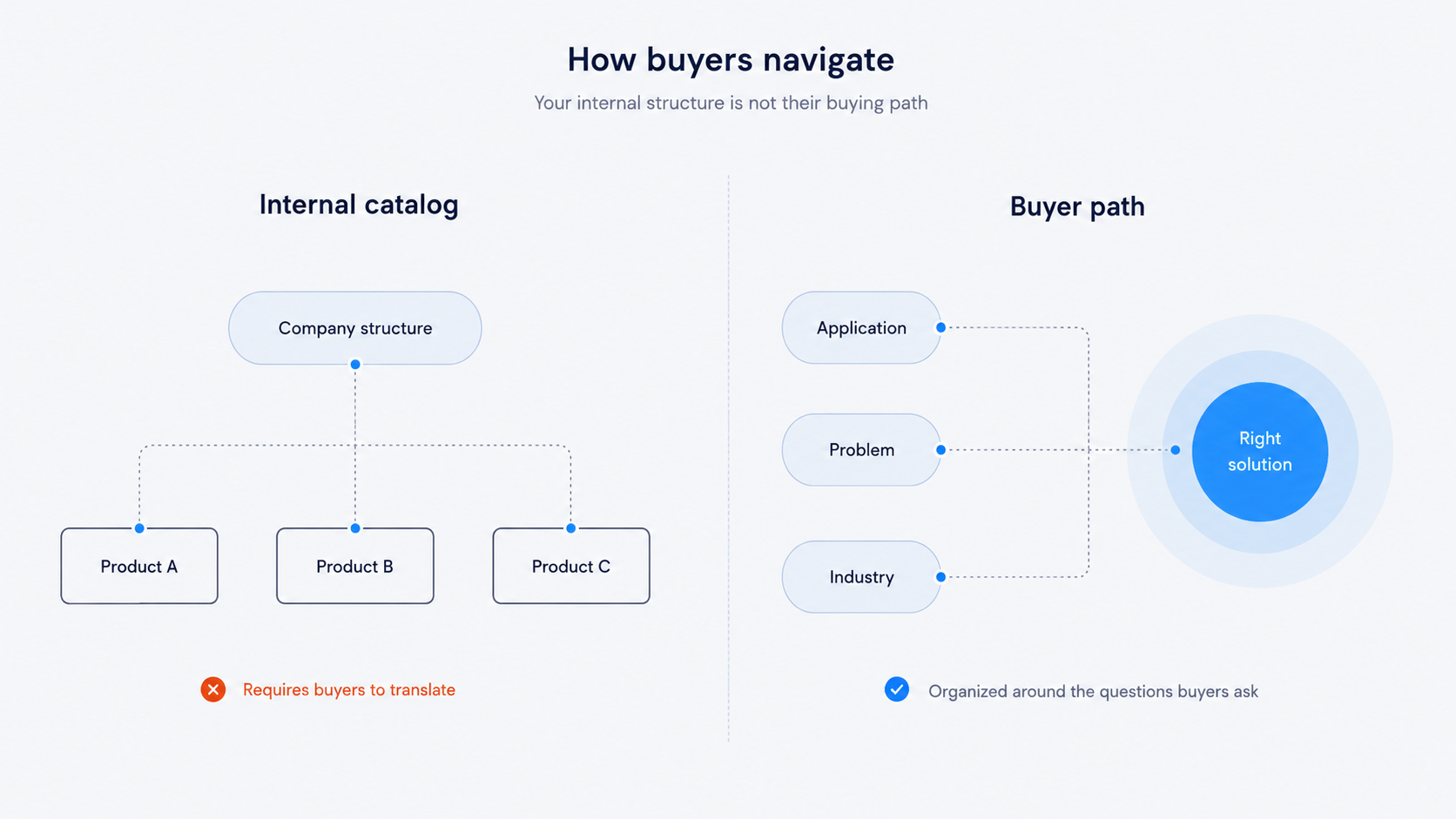
Most industrial websites are organized around the product catalog, specifically how the company thinks about what it makes. Buyers, however, navigate by problem, application, and industry. They want to know whether your product works for their specific situation, not where it fits in your internal taxonomy.
Website structure for industrial companies should reflect how buyers evaluate: application-based navigation that gets technical visitors to the right product for their context, specifications that are findable and scannable without requiring a PDF download, and separate paths for the technical evaluator and the procurement stakeholder. These two groups need different information at different points in the process, and forcing them through the same path serves neither well.
The other failure mode is organizing the site to inform rather than to progress evaluation. Buyers need comparison tables, specification selectors, and downloadable technical documents: tools for evaluation, not just descriptions of what the product does.
There’s a second benefit to putting detailed specifications on the website that most industrial companies haven’t fully considered. Searchable, structured spec data doesn’t just help buyers find you through traditional search — it’s also what AI systems read when someone asks a question about your product.
This does not mean AI or search engines cannot read PDFs. Google explicitly indexes text-based PDFs, and other retrieval systems can often process them too. But a scanned, gated, poorly tagged, or complex PDF may extract inconsistently. Key specifications should therefore exist as accessible HTML as well as in the downloadable document. HTML is easier to link, update, organize into clear sections, and enhance with structured data; Google’s own technical guidance says that, even though it can parse many file types, text remains the safest way to help it understand content.
Lead generation and measurement for long sales cycles
Long-cycle industrial sales require different lead generation logic and different attribution thinking.
Top-of-funnel content (the material that enters conversations early) is consistently underinvested in industrial marketing. Early-stage technical content takes time to build authority and generates leads that won’t convert for months. That makes it easy to deprioritize in favor of tactics that produce faster results like inbound marketing. It’s also what determines the quality and volume of pipeline six months out.
Trade shows remain high-value in industrial markets, but most companies treat them as isolated events. In Content Marketing Institute’s manufacturing study, 51% of respondents rated in-person events as an effective distribution channel, the highest result measured, just ahead of corporate blogs and webinars at 49% each. The opportunity is to connect those events to the rest of the system: pre-show targeting to warm the audience before people arrive, content that supports conversations on the floor, and structured follow-up after they leave.
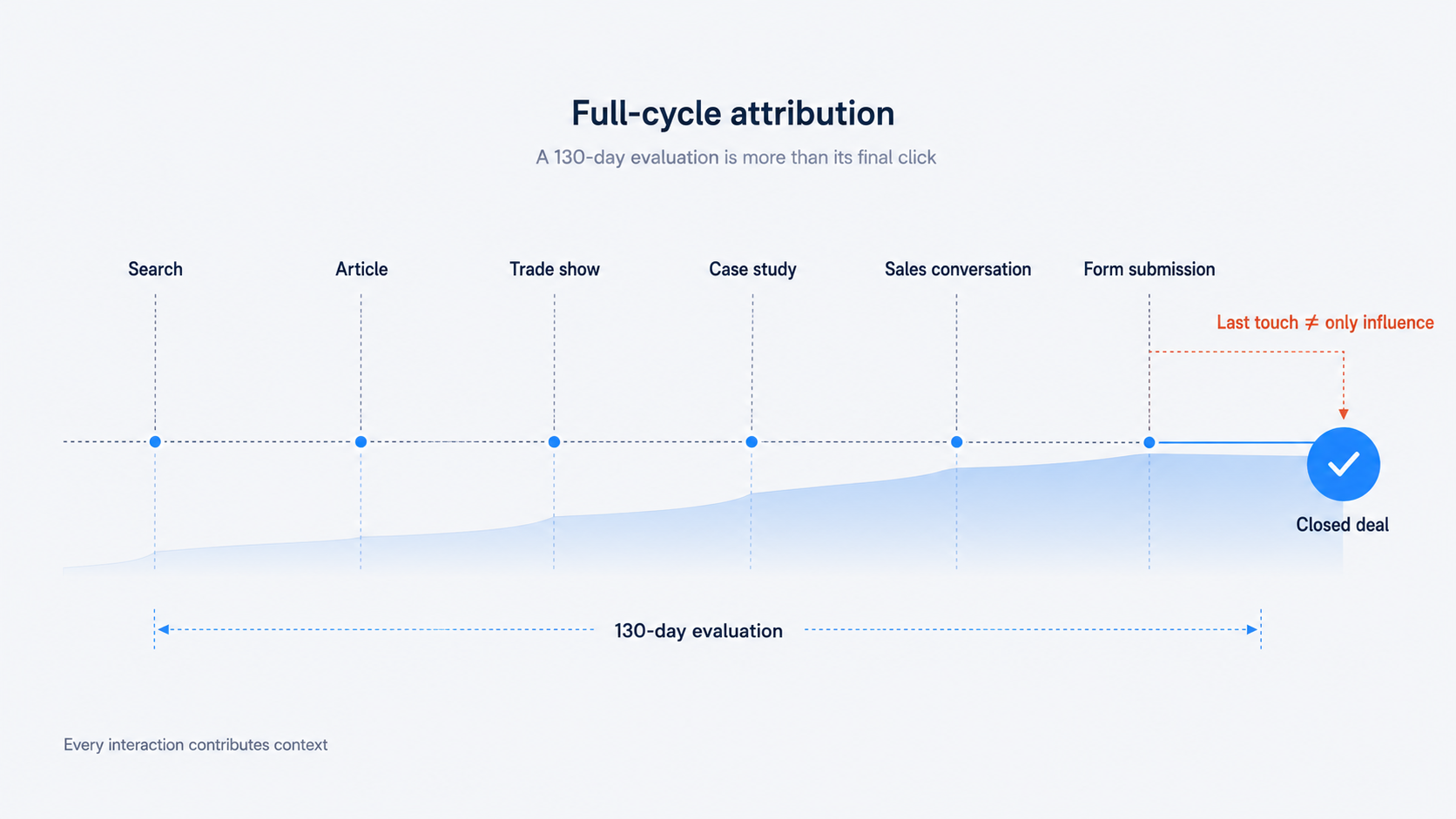
Attribution is the measurement problem that industrial marketing still hasn’t fully solved. In the same CMI study, 53% of manufacturing marketers said they struggled to tie performance to business goals, 48% lacked clear goals or KPIs, and 40% cited data silos. Last-touch attribution makes that worse: it credits whichever campaign preceded a form submission, not the application note that established credibility months earlier or the trade show conversation that put the vendor on the shortlist.
Measuring qualified pipeline influenced across the full buying cycle, not just leads generated, gives a more honest picture of what is working. It also helps marketing defend long-horizon investments that appear invisible in a short reporting window.
Common mistakes in industrial marketing
Most of these are the result of applying the wrong framework to how industrial buyers actually make decisions:
- Marketing to the approver when the conversation starts with an advocate. The person who signs off is rarely the person who initiates the evaluation. They need different content.
- Educating buyers on a category they’ve already accepted. Category-level content is only useful during early market formation. After that, buyers want vendor-level proof, not category rationale.
- Leading with benefits when buyers evaluate on specifications. In technical B2B, specification detail is the credibility signal. Generic benefit messaging reads as a sign that you don’t understand how buyers evaluate.
- One content track for a six-stakeholder buying committee. Engineers need different content than procurement managers. Marketing to a committee with a single message means it doesn’t fully serve any of them.
- Marketing to end users when the specifier makes the decision. As with architects specifying glazing, the person who writes the spec and the person who pays for the outcome are often different people operating on different timelines.
- Website organized around the product catalog instead of how buyers navigate. Structure should reflect application and industry context, not internal product taxonomy.
- Trade shows treated as standalone events. Without pre-show digital warm-up and post-show follow-up, most of the relationship value built on the show floor goes cold.
- Short-conversion tactics applied to a 130-day sales cycle. Urgency doesn’t work on buyers who are operating on their own evaluation timeline.
- Measuring leads generated rather than pipeline influenced. This mismeasure makes long-cycle marketing look like it isn’t working, which leads to defunding the exact activities that are producing results months later.
Where to start
Industrial marketing isn’t harder than other B2B marketing. It’s different. The companies that get it working stop adapting general-purpose frameworks and start building from how their specific buyers evaluate: who actually starts the buying conversation, and what content moves them at each point in the process.
Insulgard, Ashling Partners, Arbor Assays, and Modelon all had strong products and real market demand. What changed in each case wasn’t the product, the team, or the budget. Marketing started producing results when the strategy matched how buyers buy.
That’s where any industrial marketing strategy should start: not with which campaigns to run, but with who you’re actually talking to and what they need from you at each stage.
Three Seven specializes in industrial and manufacturing marketing. If any of this sounds familiar, we’d be glad to take an honest look at where your strategy currently sits.
Research cited
- “2026 State of Marketing to Engineers” GlobalSpec, TREW Marketing, and Elektor
- 2025 B2B Buyer Experience Report – 6sense
- Gartner Sales Survey Finds 74% of B2B Buyer Teams Demonstrate “Unhealthy Conflict” – Gartner
- Manufacturing Content Marketing Benchmarks, Budgets, and Trends: Outlook for 2025 – Content Marketing Institute
- The Architect’s Journey to Specification – American Institute of Architects
- GEO: Generative Engine Optimization – KDD 2024
- Optimizing Visibility in Generative Engines: A Critical Survey of GEO (2023 – 2026)
- Google Search Central guidance on indexable file types
- Three Seven’s documented Insulgard results