- Uncategorized
- Updated 08/28/2026
What Actually Gets B2B Brands Cited by AI Search in 2026 (And 5 Tactics Wasting Your Budget)
Summarize this post
Key takeaways
- Ranking #1 on Google no longer gets you cited. Only 37.9% of AI Overview citations now come from the organic top 10, down from 76% eight months earlier.
- Off-site brand mentions predict AI citation better than anything on your own website. A 75,000-brand Ahrefs study found the correlation about three times stronger than backlinks.
- A single review profile (even one with a handful of reviews) can move a brand’s AI citation rate from 1% to 53.5%.
- Reddit alone takes more first-citation slots in Google AI Overviews than 14 major publishers combined.
- Author bio boxes, llms.txt files, and Markdown copies of your pages didn’t move AI citation in controlled tests. Stop funding them. Schema won’t win citations either — but keep it as entity infrastructure, not a citation lever.
- AI pulls citations from the first 30% of a page far more than the rest. Put your answer first.
We read 27 studies covering more than 20 million AI citations (from a peer-reviewed KDD paper to controlled tests by Ahrefs and Seer Interactive) to answer one question: what actually gets a B2B brand cited when someone asks ChatGPT, Perplexity, or Google’s AI Overviews for a recommendation?
Some of the answers confirm what agencies have been saying for two years. Several contradict it directly.
Here’s what the data shows, starting with why this matters more than most marketing teams have priced in.
Your buyers are building their shortlist before they Google anything
60% of Google searches now end without a click. Among B2B question-based queries, AI Overviews show up roughly 82% of the time. Bain found that 73% of B2B websites lost significant traffic between 2024 and 2025, averaging 34% declines year over year.
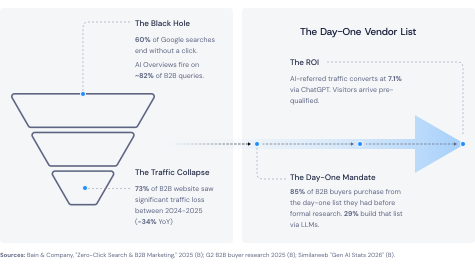
None of that is the real problem. The real problem is what Bain found next: 85% of B2B buyers purchase from their “day-one” list — the vendors they already had in mind before formal research began. Buyers are increasingly building that list inside an AI conversation rather than a search results page, and about 29% now assemble it through an LLM.
If your brand isn’t in the answer when that list gets formed, you’re not being discovered late or weighed against a competitor. You’re not in the conversation.
The traffic that does arrive through AI converts unusually well. Similarweb found ChatGPT referrals convert at roughly 7.1%, second only to paid search, because those visitors arrive already deep in evaluation.
The old shortcut is gone: rank #1, get cited
For two years, the working assumption was simple: rank in Google’s top 10 and you’ll get pulled into the AI Overview. As of March 2026, that’s no longer close to true.
In July 2025, 76% of AI Overview citations came from the organic top 10. By March 2026 that number had fallen to 37.9%, based on an Ahrefs analysis of 863,000 SERPs and 4 million AIO URLs. Across ChatGPT, Gemini, and Copilot, only about 12% of cited links rank in anyone’s top 10. Roughly 88% of AI citations live in a layer that rank-tracking software was never built to see.
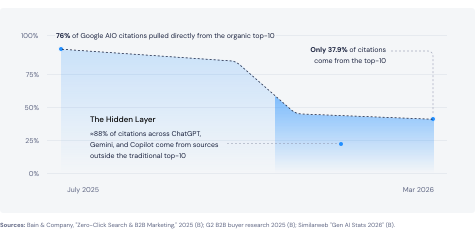
The mechanism is called query fan-out. Instead of answering your exact search, the model splits it into a cluster of related sub-questions and pulls citations from whichever pages answer any of them best, including pages that never ranked for your original keyword. YouTube alone accounts for about 18% of non-ranking AI Overview citations.
This doesn’t mean ranking stopped mattering. Being indexed and crawlable is still the entry ticket: you can’t be cited if you’re not retrievable. But ranking position for the one keyword you’re tracking has stopped predicting whether you get cited. If your SEO reporting still treats rank as the finish line, it’s measuring the wrong thing.
What we found actually works
Five findings stood out as both high-confidence (multiple independent studies agree) and high-impact. If you do nothing else in this post, act on these.
Off-site brand presence is the strongest single predictor we found, by a wide margin.
In a 75,000-brand Ahrefs study, brand mentions across the web correlated with AI Overview visibility at 0.664, roughly three times stronger than backlinks. Brands with a full off-site signal architecture earned about 7.8 times more AI mentions than those with a thin one, and 26% of the brands studied had no AI Overview mentions at all. A separate Seer Interactive study of 62 brands, controlling for confounding variables, found only a handful of signals survived statistical testing, and every one was off-site: industry-publication coverage, community mentions, branded search volume. Paid search and SERP features showed nothing.
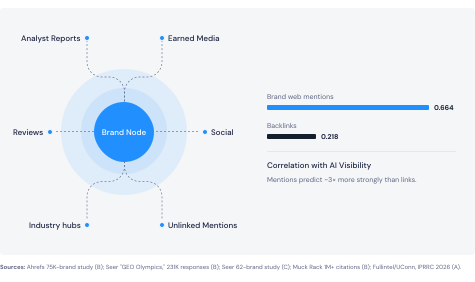
Here’s the B2B wrinkle the consumer studies miss: breadth can work against you. In that same 62-brand study, the broad-web signals that help consumer brands ran negative for B2B. TikTok (r = −0.68), Wikipedia (r = −0.63), and general news (r = −0.54) all correlated with less AI visibility, not more. The models are looking for category specialists. Go deep in the trade press, analyst coverage, and the subreddits your buyers actually read, not wide across the general web.
The reason makes sense once you know how these models are built. They’re trained on raw text, not link graphs. A mention that never gets a hyperlink can still teach the model that your brand exists and is credible, something conventional SEO has no way to reward.
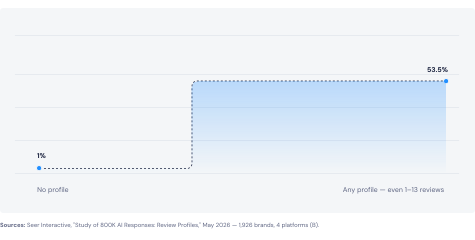
A single review profile can move your citation rate from 1% to 53.5%.
Seer Interactive analyzed 804,491 AI responses across nearly 2,000 brands. Brands with no Trustpilot profile had a median AI citation rate of 1%. Brands with any profile at all, even one with as few as 1 to 13 reviews, jumped to 53.5%. The absence of reviews isn’t read as neutral, either. ChatGPT was observed flagging it directly, noting “[Brand] lacks reviews on trusted sites like Trustpilot, BBB…” while still citing the brand’s own website. Missing reviews work as a negative trust signal, not a gap the model ignores.
Reddit outperforms every major publisher combined.
A Seer study found Reddit captures 20.4% of all first-citation slots in Google AI Overviews, more than ten times the combined share of 14 major optimized publishers, including Forbes, NerdWallet, and Investopedia. Yext separately found Claude leans on user-generated content two to four times as heavily as other models. Treat Reddit as a citation source, not a social channel. It rewards a real, substantive presence in the communities your buyers already occupy, not a promotional drive-by.
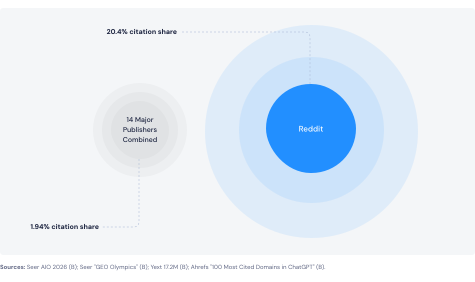
One caveat: these platform shares move. Reddit’s citation share in ChatGPT dropped sharply in mid-August 2026 for reasons that still aren’t confirmed. The mechanism holds up: earn a genuine presence where your buyers are. Any single share number is a snapshot, so track your own citations rather than trusting a headline percentage.
AI cites sentences, not pages, so where you put the answer matters
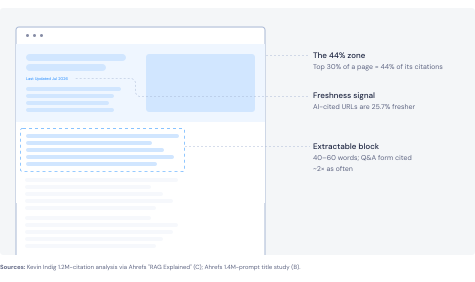
Ahrefs’ analysis of retrieval behavior found the first 30% of a page generates 44.2% of its citations. Content structured as a direct question followed by an immediate answer gets cited about twice as often as content that builds up to the point. Lead with the answer. Use comparison tables for “X vs. Y” questions. Write in self-contained 40-to-60-word blocks that make sense pulled out of context, because that’s exactly what a retrieval system does with them.
Specific, sourced claims beat generic ones, and the effect is bigger for smaller brands
In the one peer-reviewed study in our data set (researchers from Princeton, Georgia Tech, the Allen Institute, and IIT Delhi, published at KDD 2024), adding statistics to a page increased visibility by up to 41%. Citing authoritative sources increased visibility on lower-ranked pages by 115%. Adding more words with no new information produced no gain, and keyword stuffing made things measurably worse: a 10% penalty. That 115% figure matters most if you’re not yet established. It’s the lever with the highest ceiling for anyone starting from a smaller footprint.
Four tactics the data says to stop funding
Just as useful as knowing what works is knowing what doesn’t, especially when it’s still sold as best practice.
Author bio boxes correlate with lower citation rates, not higher ones.
In an 8,500-keyword Seer study, the pages with the heaviest author-bio coverage had the lowest AI Overview citation share of any group studied. Entity-level authority, being an established brand that other sources corroborate, still matters. The bio box itself doesn’t.
Ranking yourself #1 on your own “best of” list backfires nearly half the time.
An Ahrefs tracking experiment found the tactic works only as a gap-filler for brands with little existing footprint. For an established brand, it barely moves anything. And when AI does cite a self-promotional page, it skips recommending that brand in favor of a competitor 43% of the time. Fill a genuine information gap; don’t crown yourself.
llms.txt files are essentially unused.
An Ahrefs analysis of 137,000 domains found that 97% of published llms.txt files were never fetched in a month, and AI-search bots accounted for just 1.1% of the reads that did happen. The file’s real audience turned out to be coding agents, not search crawlers. Google’s own documentation says plainly that it ignores these files.
A clean Markdown version of your page doesn’t help either.
Profound ran a randomized controlled trial across 381 pages and found no statistically significant increase in AI bot traffic from serving a Markdown copy. A head-to-head test from OtterlyAI told the same story: the Markdown version got cited 0% of the time against its HTML twin at 7.4%. AI reads your HTML. A parallel Markdown pipeline spends effort on an audience that isn’t there.
One tactic to reframe, not kill: schema markup
Schema gets sold as an AI-citation lever, and as a citation lever it doesn’t hold up. A controlled Ahrefs study tracked 1,885 pages that added JSON-LD against 4,000 matched pages that didn’t, and found no meaningful lift on any platform. In live tests, the models read your visible HTML and ignore the markup at fetch time.
But that study measured one narrow thing: whether content schema (FAQ, HowTo, Article) pushes an already-cited page higher. And it pooled every schema type together. It says little about entity schema (Organization, Person, sameAs), which does its work upstream, at indexing and entity resolution, where Google decides who you are. So don’t buy schema to earn citations next quarter. Do keep it as low-cost entity infrastructure, especially if your brand isn’t yet established in Google’s Knowledge Graph. It’s plumbing, not a lever.
Where we’d start
If none of this exists yet, the highest-leverage sequence is short:
- Confirm AI crawlers can actually reach your site (check robots.txt and your CDN’s defaults, since Cloudflare blocks AI bots out of the box)
- Claim a review profile on whichever platform matters in your category
- Rewrite your two or three highest-value pages to lead with the answer instead of building up to it
- Find low-effort offsite mention opportunities like relevant business and industry directories and associations
That covers the five findings above. It’s a fraction of what we found.
There’s a lot more underneath this
This post covers 5 of the 17 factors we rated across the full research set. They’re the ones with the strongest evidence and the clearest path to action. The full report goes further: the other 12 factors (including the ones where credible studies genuinely disagree, like whether long-form content still helps), the confidence-and-evidence grade behind every claim, the B2B-specific findings that invert what works for consumer brands, and the five-phase rollout we’d actually run for a client, from the technical audit through the earned-media program.
It also includes the full source list across all 27 studies, so you can go verify any of it yourself.
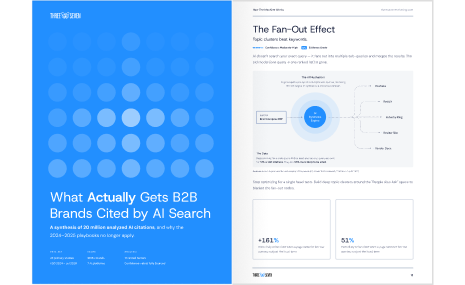
Free Report: What Actually Gets B2B Brands Cited by AI Search in 2026
Sources
- Bain & Company. “Zero-Click Search & B2B Marketing.” 2025.
- G2. B2B buyer behavior research. 2025.
- Similarweb. “Gen AI Stats 2026 / Generative AI Brand Visibility Index.”
- Ahrefs. “Update: 38% of AI Overview Citations Pull From The Top 10.” March 2026. (863K SERPs / 4M AIO URLs)
- Ahrefs. “AI Overview Brand Visibility Factors (75K Brands).” May 2025.
- Seer Interactive. “What If the Best GEO Strategy Is the One You Stopped Investing In?” March 2026. (62 brands, FDR-corrected)
- Seer Interactive. “Study of 800K AI Responses: Review Profiles.” May 2026.
- Seer Interactive. “What It Takes To Rank In Google’s AI Overviews in 2026.” (8,500 keywords / 6,354 pages)
- Yext Research. “AI Citation Behavior Across Models: 17.2 Million Citations.” Q4 2025.
- Ahrefs. “Retrieval Augmented Generation (RAG) Explained.” July 2026.
- Aggarwal, P., et al. “GEO: Generative Engine Optimization.” KDD 2024. arxiv.org/abs/2311.09735
- Ahrefs. “We Tracked 1,885 Pages Adding Schema. AI Citations Barely Moved.” May 2026.
- Seer Interactive / Ahrefs. “Self-Promotional Content Works Until It Backfires.” July 2026.
- Ahrefs. “Does llms.txt Help AI SEO? 137K Domains.” 2026.
- Profound (Punturo, B.). “Does Markdown Increase LLM Bot Traffic? A Randomized Controlled Experiment.” February 2026.
- OtterlyAI. “HTML vs Markdown: What Impacts AI? A GEO Experiment.” 2026.
- Promptwatch (Foppen, K.). “Reddit Citations Are Dropping in ChatGPT.” August 2026.
- Google. “Guide to Optimizing for Generative AI Features on Google Search.” Search Central documentation, 2026.
This post draws on 18 of the 27 studies in our full report, What Actually Gets B2B Brands Cited by AI Search. The remaining 6 sources, and the full confidence-and-evidence grading for every claim, are in the download.