

A site rebuilt around expert buyers and a sharper Goldilocks position drove 109% keyword growth, roughly 3x lead volume, and a pipeline busy enough that the team has trouble keeping up — including inbound from AI search.
109%
Year-over-year increase in ranking organic keywords, sustained through ongoing optimization.
3X
Growth in monthly leads since website launch.
10+
High-value keywords ranking in the first position on Google.
40+
High-intent AI Prompts citing Lindsay Exhibit Group.
Project overview
Background
Lindsay Exhibit Group has been designing and building custom trade show exhibits since 2002, serving clients with five to six-figure exhibit design budgets.
That’s an unusual spot in the industry — bigger than the online kit shops competing on price below them, smaller than the multimillion-dollar custom houses competing on scale above. Lindsay Exhibit Group sits in the middle: custom design, expert guidance, full logistics, without the price tag of the top tier.
The existing site didn’t show any of that. Six years old, structured like a digital brochure, and built before the company had a clear sense of who it was selling to. The site existed. It just didn’t do anything.
Issues to solve
- The site was speaking to beginners. The buyers were experts. Lindsay Exhibit Group’s prospects were marketing managers and trade show professionals who already understood the category. They didn’t need to be sold on why exhibits matter. They needed proof that Lindsay specifically was different from the alternatives they were already considering.
- The Goldilocks position wasn’t visible. Lindsay Exhibit Group sat between commodity online competitors and multimillion-dollar custom houses, but the site didn’t make that distinction. Right-fit buyers had no reason to see Lindsay as the obvious choice, and wrong-fit buyers kept reaching out anyway.
- The brochure structure couldn’t generate or qualify leads. No structured proof, no buyer-specific paths, no tools connecting the site to the sales process.
Our solution: A site rebuilt around expert buyers, anchored on the Goldilocks position, with sales tools and a marketing engine sized to compete locally and nationally.
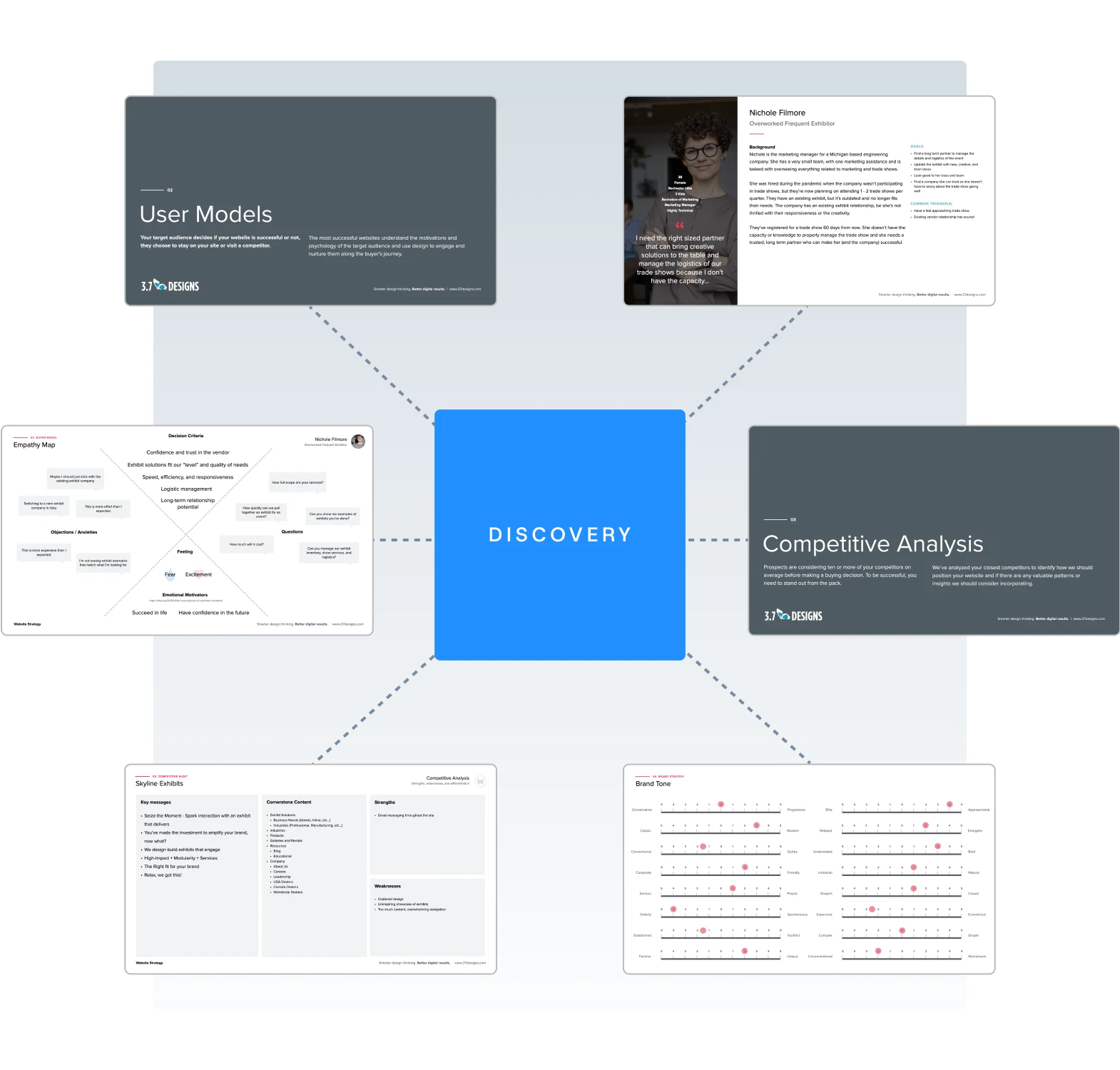
Discovery & strategy
Discovery surfaced three buyer types: regular exhibitors managing several shows a year, occasional exhibitors running one or two, and one-and-done buyers needing a single solution. The first two were the right fit for Lindsay Exhibit Group’s project size and service depth. The third was usually a budget mismatch.
The site was structured around regular and occasional exhibitors and let one-and-done buyers self-select out. Every wrong-fit conversation was time the sales team wasn’t spending on the right ones.
Positioning the Goldilocks middle
Pop-up shops competed on speed and price. Custom houses competed on scale and budget. Lindsay Exhibit Group’s pitch — custom design at an obtainable price, with the experience to guide buyers through their first or hundredth show — needed to be the explicit story the site told.
Messaging built for experts
So pages skipped the category-level setup and got straight to what Lindsay Exhibit Group specifically does, who they do it for, and what makes them different from the alternatives the buyer is already evaluating.

Building a website to drive the strategy

Sales tools, not marketing showcases
The custom WordPress build included case study, portfolio, and testimonial managers — but the most consequential one was the portfolio manager, and it was built for sales rather than marketing. Lindsay Exhibit Group’s sales team uses it live during prospect calls, walking buyers through relevant projects in real time. That changed what the tool needed to do: filter quickly by industry and exhibit type, surface examples on demand, work as a presentation surface rather than a passive gallery.
Forms and CTAs were designed to attract the $20–100K project range and quietly de-prioritize buyers outside it. No hard gates — just clear signals about who Lindsay Exhibit Group works with.

SEO & Demand Generation
The default move for a Michigan exhibit company would be local SEO — Southeast Michigan, Detroit metro. Keyword research told a different story. There was real, uncontested opportunity at the state level, where Lindsay Exhibit Group could compete for Michigan-wide terms without fighting national players. There were also targeted national keywords — specific exhibit types and project categories — where a regional company could rank.
The program was built around Michigan-wide visibility plus a focused set of national terms, rather than a narrow local campaign that would have capped the upside.
Rankings climbed steadily through year one and accelerated in year two. The foundation has since started showing up somewhere we didn’t explicitly optimize for: AI-driven search. Lindsay is now generating inbound from generative AI queries — the same content and structural decisions that drove traditional search performance carrying into emerging channels.

