
- Digital and Design Strategy
- Digital Marketing
- Updated 11/13/2026
Minimum Viable Multichannel
Summarize this post

Summary: B2B buyers use an average of ten channels before they buy, and a two-person marketing team is never going to run ten. Minimum viable multichannel is the smallest version that still works: make one asset a month, keep two in the queue, pull four or more angles out of each one, run each angle two to four times, and repackage per channel. Four angles run four times is 16 pieces from one asset, which is a month of posting without starting from a blank page.
Multichannel, as most people picture it, is a YouTube program, ads on three platforms, a weekly newsletter, and a steady stream of LinkedIn posts, all running at once. That picture is a team of eight and a budget to match. It’s a mountain.
Most small teams have the capacity to step over a medium-sized rock.
So they do one of two things. They do nothing, or they pick one channel and run it halfway.
Meanwhile buyers have doubled the number of channels they use, from five in 2016 to ten today. That figure comes from McKinsey’s 2026 Global B2B Pulse Survey, which covers nearly 4,000 decision makers across 13 countries. McKinsey’s 2024 survey found the same average of ten, and 42% of those buyers said they used more than 11 different touchpoints.
People rarely see you once and then buy, so one channel run halfway covers a sliver of that journey. Two channels, run every month, cover more than that, and a small team can hold two.
We see this a lot with technical companies running lean marketing teams. The problem usually isn’t effort or budget. It’s that the only version of multichannel they can picture is the big one.
What minimum viable multichannel is
Minimum viable multichannel is the smallest version of multichannel marketing that still works. You make one solid piece of content a month, then get as much distribution out of it as you can.
It runs on five steps:
- Make one asset a month.
- Stay two months ahead.
- Find the angles.
- Run each angle two to four times.
- Repackage for each channel.
None of these steps are hard on their own. Doing them every month is the hard part.
Step 1: Make one asset a month
Start with one thing a month. That’s twelve a year.
An asset can be an article, a video, a webinar, a calculator, a checklist, or a case study. The format matters less than what’s in it. It needs enough substance that you can pull several ideas out of it.
The test we use: could you talk about it for twenty minutes without repeating yourself? A quick tip fails that. A detailed walkthrough of how you solve a specific problem passes it easily, and so does anything where you had to make decisions along the way, because every decision is something to explain.
Three kinds of asset stretch especially well:
- Something you built. A calculator, a configurator, a template, a checklist. You can talk about what it does, who it’s for, how you built it, and what you learned from watching people use it.
- Something you measured. Your own data, a client’s results, a survey of your market. Numbers give you a claim to defend, and a claim people argue with is worth more than a tip nobody disputes.
- Something you figured out the hard way. A process you rebuilt, a mistake that cost you a quarter, a belief you changed your mind about.
Some assets don’t stretch: a roundup of other people’s advice, a product announcement, or anything where your honest summary is one sentence long.
If you’re not sure where to start, look at the questions your sales team answers over and over. Those topics are already proven, and the answers already exist in the heads of the people who give them.
Step 2: Stay two months ahead
Keep two finished assets in the queue before you start publishing. This is the part that keeps the whole thing alive.
Without a buffer, one busy month breaks the streak. Then it’s easy to tell yourself you’ll restart next quarter. With two months in the queue, a bad month just means you’re one month ahead instead of two. You catch up and keep going.
In practice the queue is small and boring. It’s two finished assets, each with its angles already written down, and a rough idea of what the third one will be. That’s it. It lives wherever you already work, and the only rule is that an asset doesn’t count as queued until it’s finished.
October publishes what you made in August. November publishes what you made in September. The month you lose to a trade show or a product launch costs you a slot in the queue, not a gap on your channels.
If you hit a longer stretch, go back to the shelf. Pick an asset you made six months or a year ago and make it this month’s asset. You probably have new results since then, a new client example, or a clearer way to explain it. That’s enough to make it worth running again.
Most people who saw it the first time won’t remember it. Most people didn’t see it at all.
Step 3: Find the angles
An angle is one way into the asset. Most assets have at least four.
Here’s what the angles look like for a website audit checklist:
| Angle | What it covers | Example post |
|---|---|---|
| What it is or does | The asset itself and who it’s for | The 20 things we check before we touch a client’s website |
| What came out of it | Results, client stories, your own use | A client ran the checklist and found their demo form had been broken on mobile for months |
| How it’s built and why | The method or thinking behind it | Why the checklist starts with messaging before anyone opens a design file |
| The problem it solves | The situation that made it necessary | Teams redesign their site without knowing what’s broken |
Those four are a starting point. Most assets hold more. Some assets have a strong opinion in them. Some have a mistake you made along the way. Some have a number that surprised you. Each of those is its own angle.
Take a different asset and the same four questions produce completely different material. Say you published original research: a survey of 200 engineers about how they choose suppliers.
- What it is: what you asked, who answered, and why you ran it in the first place.
- What came out of it: every individual finding. A survey with nine findings gives you nine angles.
- How it’s built: how you got 200 engineers to answer a survey, which is its own useful story for anyone who has tried.
- The problem it solves: the decision people are making badly without this data.
- The argument: the one finding that contradicts what your industry believes. This is usually the strongest angle in the whole asset.
Write the angles down as soon as you finish the asset. It takes about ten minutes and gives you a month of content. Do it later and you’ll be re-reading your own work trying to remember what was interesting about it.
Step 4: Run each angle two to four times
Each angle can carry more than one post. If you have three client results, that’s three posts. If the method has four parts, that’s four.
Space them out. Rotate through the angles so each one comes back every few weeks instead of running back to back.
It’s also fine to post the same idea worded differently. This is the step people resist most. It feels repetitive to you because you’ve seen every post. Your audience hasn’t. Most people scroll past most posts, and the ones who caught it the first time have probably forgotten it. Saying something again is often how it finally sticks.
Four angles run four times each is 16 pieces from one asset. You won’t post all 16, and some will be weaker than others, but you stop starting from a blank page every week.
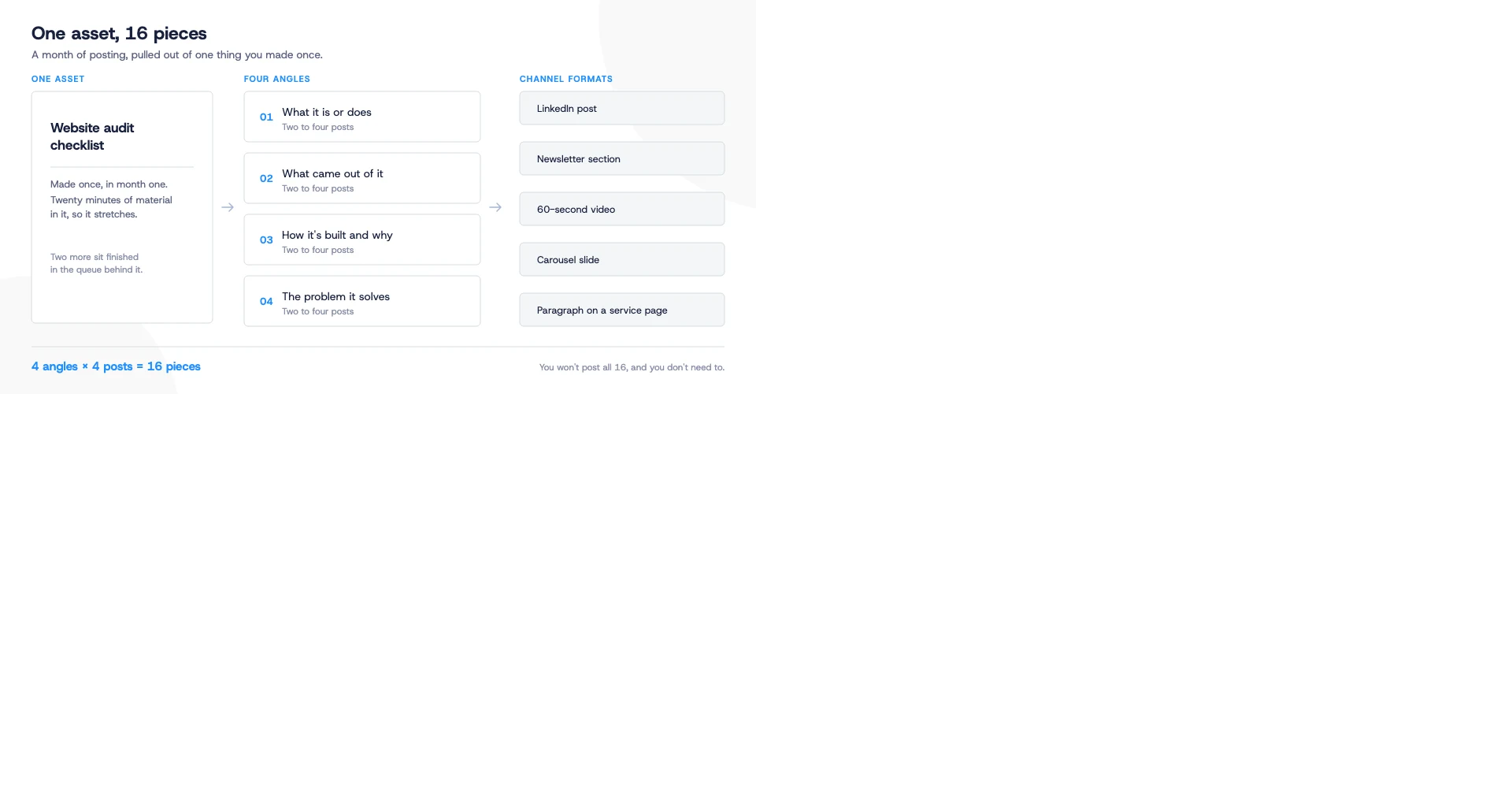
Step 5: Repackage for each channel
The same angle can show up in several places, in several formats:
- A LinkedIn text post
- A section of your email newsletter
- A 60-second video clip
- A slide in a carousel
- A short paragraph on a related service page
You’re changing the format, not making something new. Start with the one or two channels where your buyers already spend time. Add a third once the first two feel routine.
This is what makes it multichannel. One good idea, showing up in the places your buyers already look.
Two channels won’t cover the ten channels McKinsey counted. They will cover more than the one channel you’re running now, and they’ll do it every month instead of in bursts.
Spreading one idea across channels also feeds something your analytics won’t show you. When we read the research on what gets B2B brands cited by AI search, off-site mentions predicted AI citation better than anything on a company’s own website: an Ahrefs study of 75,000 brands put that correlation about three times stronger than backlinks.
A month on one page
Put together, a month looks like this. You finish one asset and add it to the queue, behind the two finished assets already in there. You publish eight posts, two a week, rotating through four angles from the asset you finished in August. One of those posts becomes a section in the newsletter, and one becomes a 60-second clip.
The writing time is in the asset. Everything after it is formatting.
How to start this month
- Pick your first asset. If you already have one, use it.
- Write down at least four angles from it.
- Choose one or two channels to start.
- Plan two posts a week for the next four weeks, rotating through the angles.
- Start on the next two assets so you’re building the buffer.
Where it goes from here
Multichannel doesn’t have to start big. One asset a month, two in the queue, and a habit of getting everything you can out of each one. That’s enough for a small team to show up consistently in more than one place.
This post doesn’t cover how you’d know it’s working. When the clicks don’t come, the numbers to watch are branded search and direct traffic, which we covered in the zero-click content framework.
Once it’s running, you can add to it. A second asset a month, another channel, or paid promotion behind the posts that do well. None of that is needed to start.